|
|
AfroCubaWeb
|
|
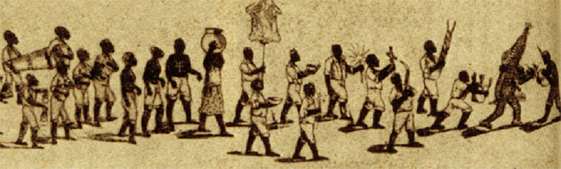
Abakuá - Abakwá - Abacuá - Ñáñigo - CarabalíesAbakuá members derive their culture from the Efik and Efo of the Cross River region in Nigeria, which Cubans call Carabali. They are organized in a set of over 150 potencias (lodges) located mainly in Havana, Matanzas, and Cardenas. The people of Big Qua Town in Calabar, the capital of Cross River State, Nigeria, are known as the Abakpa, the likely source for the name Abakuá. Big Qua Town is the home of the president of the Calabar Mgbe or Ékpè. The Cuban Abakuá societies have a male-only membership, their Ékpè equivalent in the Cross River State are called lodges in English, they are fraternities. Both the Cuban and Nigerian lodges are Ékpè lodges. In Calabar, there are also women's societies, which were not transferred across the Atlantic. Ñáñigo is a negative term, dating back to the 19th and early 20th century when there was an intense repression of the Abakuá for their supposed associations with criminal gangs. There is also in Cuba an Efo cultural manifestation organized along family lines, the Brikamo, carried by the Calle family in Matanzas. In 2001, the Efik National Association in the US began to have contact with Cuban Abakuá. There is evidence of prior contacts between the Abakuá and the Efik in Cuba, but the contact has not until now been sustained. Among such evidence is a plaque hanging on the walls of a traditional leader of the Efiks. The Abakuá gave us the rumba, one of Cuba's principal musical traditions. The Calle family, for example, is of Efo origin and is said to have invented the guaguanco, a type of rumba.
Abakuá since the Revolution has undergone a number of changes, some of which are documented in an article on the Buro Abakuá (El Consejo Supremo de la Asociación Abacuá de Cuba), a state organization that now oversees the potencias in an effort to corral maroon africans from the point of view of a republicanismo ideology. Since around 2010, there has been a shift in official attitudes and Abakuá are now being viewed in a less negative way than they had been previously, so long as they are under state control. Abakwá Links/Enlaces
|
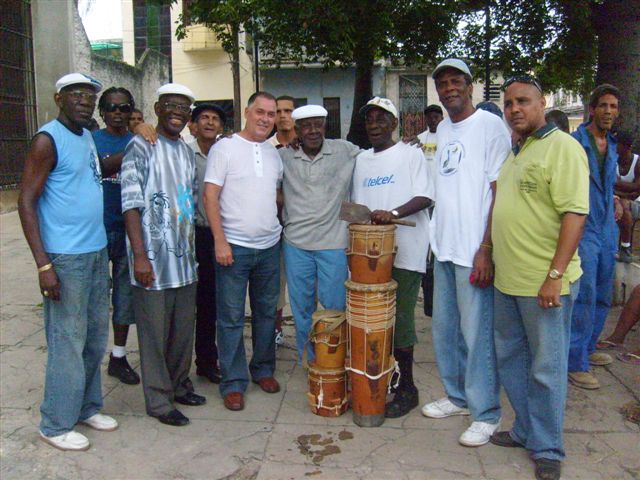
Homenaje for Ignacio Piñeiro in Jesus Maria, an Abakwá barrio in Havana
This was filmed in a documentary by an Italian company, out in June
2009
Left to right: El Goyo Hernandez, Pedrito El Yuma, Frank Oropesa,
bongocero for el Septeto Nacional de Ignacio Pineiro, El Negro Bonko de
Ibonda, Palillo Bonko de Mutanga, Ismael Bonko de Ikanfioro. All are
Abakwá musicians.

El íreme Abakuá / Bárbara Balbuena Gutiérrez. Ciudad de La
Habana :
Editorial Pueblo y Educación, c1996.
Ecorie Abakuá : cuatro ensayos sobre los ñáñigos cubanos / Tato Quiñones.
[La Habana] : Ediciones Unión, 1994.
Abakuá : una secta secreta / selección de textos Adriana Pérez Pérez,
Norma García Cabrera. Ciudad Habana, Cuba : Publicigraf, 1993.
Afro-Cuban religious experience : cultural reflections in narrative /
Eugenio Matibag. Gainesville : University Press of Florida, c1996.
Como suena un tambor abakuá / Arturo Lino, Neira Betancourt. Ciudad de La
Habana: Editorial Pueblo y Educación, c1991.
AfroCuba : an anthology of Cuban writing on race, politics and culture /
edited by Pedro Perez Sarduy and Jean Stubbs. Center for Cuban Studies.
Melbourne, Vic. : Ocean Press ; London : Latin American Bureau ; New York,
NY, USA : Distributed in the USA by the Talman Co., 1993.
The Afro-Hispanic Abakuá : a study of linguistic pidginization / by
Raphael A. Núñez-Cedeño, Roberto Nodal, [and] Rolando A. Alúm. Milwaukee :
University of Wisconsin-Milwaukee, 1982.
La Sociedad Abakuá y su poesía / Julio A. León and René León ; preface by
Antoine Oubari. Charlotte, N.C. : [s.n.], 1975.
The Abakuá language in Cuba : a glossary / compiled by Roberto Nodal.
[Milwaukee] : Dept. of Afro-American Studies, University of
Wisconsin--Milwaukee, 1976.
Linguistic folklore in the latin caribbean : a selected glossary of the
Abakuá language in Cuba / by Roberto Nodal, Rolando A. Alum, Rafael
Núñez. [Milwaukee]: Department of Afro-American Studies, University of
Wisconsin-Milwaukee, 1977.
On Abakuá rhythms
www.cse.ogi.edu/Drum/groove/abakua.html
Album des photos prises en parallèle au film "Jour des Rois,
jour Abakua" le 6 janvier 2008 (jour des Rois) par Daniel Chatelain et José
Antonio Betancourt.
picasaweb.google.com/ritmacuba/JourAbakua - plenty good photos here!
ndiboyevengo.blogspot.com
N'dibo Yeve Ngo Blog
freimaurer-wiki.de/index.php/En:_Abacu%C3%A1_-The_Caribali_'Masons'_of_Cuba
Bibliography on Abakwa music
www.lameca.org/dossiers/abakua_music/eng/sources.htm
Consejo Supremo Abakuá de Cuba - Buró Abakuá - Asociación Abakuá de Cuba: centralized state run organization designed to rule over the Abakwa potencias.
[AfroCubaWeb] [Site Map] [Music] [Arts] [Authors] [News] [Search this site]